What TGA-approved means#
The Therapeutic Goods Administration regulates disinfectants in Australia. A TGA-approved product has been assessed to kill specific organisms at specific concentrations, meet Australian safety and efficacy standards, and hold that performance under real conditions. Listed products appear on the ARTG.
Supermarket "antibacterial" sprays are household products. They are not held to the same testing standard, and their claims are not equivalent.
Why contact time is the part that gets skipped#
Every disinfectant has a dwell time — the period the surface must stay visibly wet for the product to work. For most gym-appropriate products that is 30 to 60 seconds. Spraying and immediately wiping removes the product before it has acted.
This is the single most common failure in gym cleaning, and it is invisible. The surface looks clean and smells clean. It is why Staphylococcus aureus persists on handles and grips in facilities that are wiped down every day.
Why gyms are a distinct case#
High pathogen load. Sweat, skin cells and respiratory droplets mean gyms carry more biological contamination per square metre than most commercial environments.
Equipment compatibility. Many commercial disinfectants contain bleach, ammonia or alcohol at concentrations that degrade rubber grips, crack vinyl upholstery and fog display screens. An effective product that destroys the equipment is not a solution.
Immediate skin contact. Members touch treated surfaces minutes after cleaning. Hospital-grade products are formulated for exactly that.
What gets treated#
- Door handles, entry points and reception surfaces
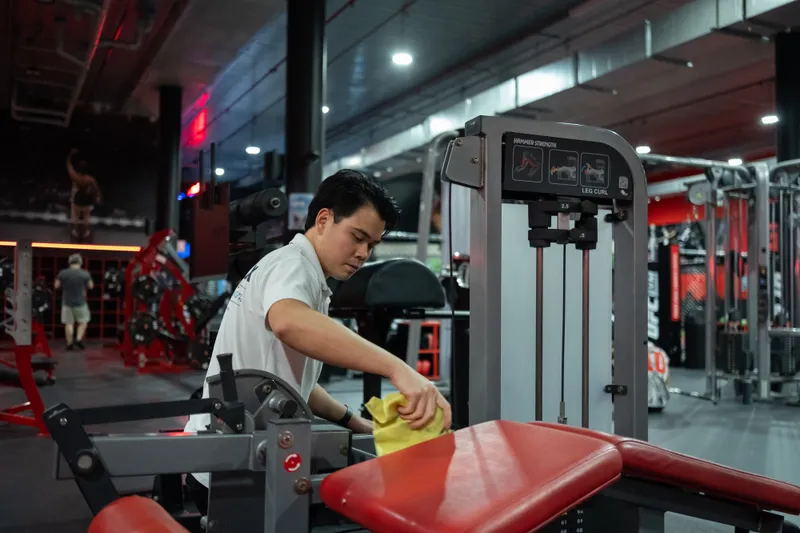
- Cardio consoles, screens and handles — the slowest surfaces to do properly, because each needs its full dwell time
- Free weight racks, dumbbell handles and barbell knurling
- Bench pads, seat pads and adjustment points
- Cable machine handles and attachments
- Any shared contact point on the members' path through the facility
Cross-contamination control matters as much as the product: working clean-to-dirty, and not carrying a cloth from a wet area onto the training floor.
Five questions worth asking any cleaner#
- Are the products TGA-listed, and can you show me the ARTG entry?
- Which organisms do they kill?
- What is the required contact time, and is your route timed to allow it?
- Are they safe for skin contact once dry?
- Will they damage rubber, vinyl or screens?
A cleaner who cannot answer these is using generic product. Under the WHS Act 2011 and SafeWork NSW guidance, the chemicals used in your facility are your risk as the operator, not only theirs.