What a gym deep clean actually covers#
Daily cleaning keeps a facility presentable. Deep cleaning addresses what daily cleaning cannot reach, and the two are not substitutes for each other.
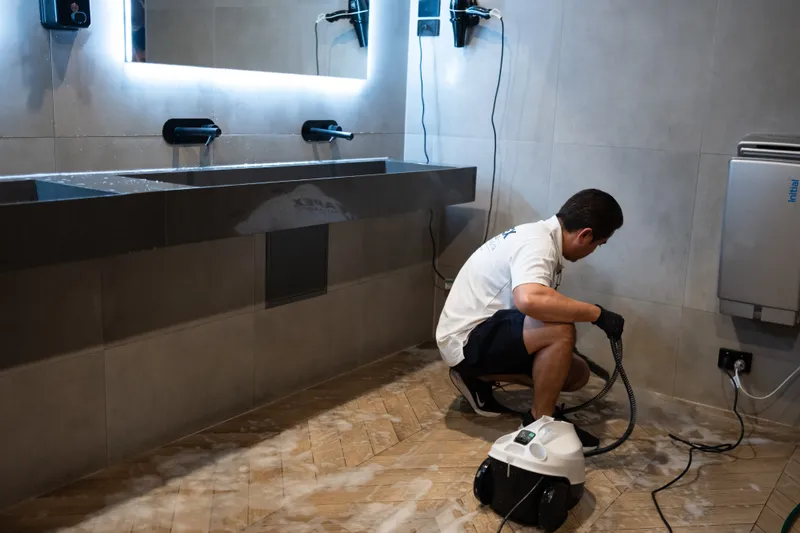
- Floors — pressure scrubbing rubber, turf and tile, then treating and resealing rather than mopping over accumulated product residue
- Grout and wet areas — stripping discoloured grout lines back, treating them, and clearing drains rather than wiping around them
- Equipment — deep sanitisation of surfaces that a between-session wipe never contacts: seat pad seams, adjustment pins, the underside of benches, cable housings
- Air vents and hand dryers — detailed cleaning of fixtures that collect dust and aerosolised moisture
- Edges and voids — behind equipment, beneath racks, along skirtings, and the corners a daily route is not scoped to include
- Glass — internal and external windows, frames and partitions
How often should a commercial gym be deep cleaned?#
Interval scales with traffic and operating hours:
- High-traffic facilities (500+ members, twelve or more hours a day) — every 4 to 6 weeks, with a full facility reset quarterly
- Mid-size gyms (200-500 members) — every 6 to 8 weeks, full reset every 6 months
- Boutique studios (under 200 members) — every 8 to 12 weeks, full reset annually
Stretching the interval does not save money. It converts a scheduled, predictable job into a larger restoration job later.
What accumulates without it#
Four things build up in a gym that is cleaned daily but never deep cleaned:
- Floor buildup — layers of cleaning product residue, dead skin and dust that mopping redistributes rather than removes
- Grout contamination — bacteria and mould embedding into porous grout lines, which is why grout darkens or turns pink even in showers that look clean
- Equipment biofilm — a thin organic layer that forms on surfaces and that regular wiping does not penetrate. Biofilm matters because it shields organisms underneath it: a disinfectant that would kill Staphylococcus aureus on a clean surface may not reach it through an established film, which is why deep cleaning is a mechanical job before it is a chemical one
- Drain blockages — hair, soap and organic matter accumulating under covers, producing odour before they produce a blockage
These compound. A gym six months past its last deep clean has a materially different hygiene standard than one on a monthly rotation, even where the daily cleaning is identical.
How Apex schedules deep cleaning#
Deep cleaning is built into the maintenance schedule from day one rather than booked reactively once a facility has visibly slipped. New clients start with a full hygiene reset, then move onto daily maintenance with structured project rotations, so every area of the facility gets periodic deep attention on a known cycle.
Work is scheduled off-peak or overnight so members are not affected, and every visit is documented with photo verification. Products are TGA-approved and hospital-grade, listed on the ARTG and applied at their stated contact time — a deep clean uses the same product discipline as a daily clean, just with mechanical work behind it.
Chalk, rubber and functional-training floors#
Facilities with a functional-training or CrossFit-style floor need more from a deep clean than an equipment-only gym does. Chalk dust travels and settles well beyond the platform area, dropped barbells drive grit into rubber seams, and the flooring itself needs a product that lifts residue without degrading the rubber. This is a scrubbing-and-extraction job, not a mopping job.